Label-free characterization
Detect the undetectable and drive deeper insight with Creoptix® WAVEsystem
Label-free interaction analysis techniques are used in the direct study of native molecules. They generate biologically relevant data that enable the understanding of molecular interactions without using artificial probes or labels and therefore provide data that is more likely to reflect the natural behavior of these molecules. This is key to providing a robust body of knowledge to help develop a good understanding of structure-activity relationships, central disease research and to discover safe and efficacious drugs.
Importantly, label-free technology allows researchers to carry out analyses that are simply not possible using conventional methods that provide only end-point results. These include kinetic and affinity analysis, and evaluation of binding specificity, which are enabled by the dynamic, real-time interaction analysis afforded by label-free monitoring.
Since common additives to protein solutions can interfere with the detection of fluorescent labels, label-free assays typically work in most biological buffers. Label-free methods are also desirable because they are typically compatible with real-time detection. Label-free technologies are attractive to researchers across a diverse range of applications, such as: biological research, biotherapeutic and small molecule drug discovery and development, immunogenicity studies, and vaccine development.
Several label-free approaches for the detection of biomolecular interactions are currently available. These include the use of optical biosensors, such as GCI, diffraction, quartz crystal microbalance and microcalorimetry.
Conventional and established bioassays, such as enzyme-linked bioabsorbant assay (ELISA) or bead-based flow cytometry, use labeled reagents to detect and monitor biomolecular interactions. An immobilized ligand is used to capture a target analyte from the solution and then a specialized detection reagent, usually an enzyme or fluorescent dye, is used to give a measurable readout.
Since the readout relies on additional, artificial manipulation of the assay components, label-based assays can only be used to measure an analyte’s interaction at a predetermined concentration and fixed point in time. This means that kinetic analysis isn’t possible.
In addition, the labels themselves can introduce issues. They are often not inert and can directly alter the molecular structure or function of the analyte, or create an unwanted background signal by interacting, non-specifically, with other bioassay components. This can result in skewed, unreliable and poorly reproducible results.
Unwanted interactions are a particular issue when working with complex samples, such as cell culture supernatants, serum or plasma, where a wide range of, sometimes unknown, additional components may be present.
The label-free ligand immobilization is typically achieved by covalently coupling the ligand to the biosensor using naturally occurring amine, thiol or aldehyde groups attached to the biosensor surface. Using this technique, the ligand is immobilized in its natural form.
Alternatively, the capture approach can be used for protein immobilization, taking advantage of a high-affinity interaction between the ligand and a capturing molecule that has been covalently immobilized on the surface.
Impedance or optical biosensors are then used to measure the analyte associating and dissociating with the ligand, giving valuable information about the kinetics and affinity of the binding interaction. Crucially, this is done in real-time, without artificial manipulation of the assay components.
Because label-free interaction characterization is a dynamic and real-time technique, it opens a whole new realm of evaluation. Kinetic and affinity analysis can be explored in real-time, alongside evaluation of the binding specificity, providing more depth to the insight and answering a greater number of scientific questions, such as:
Following its integration in January 2022, Creoptix is now a Malvern Panalytical brand. The Creoptix WAVEsystem helps researchers make discoveries that simply aren’t possible with conventional bioassay methods. High-quality data can be derived from even the most challenging sample types with superior resolution and robustness.
The power behind this system is in the patented GCI technology and non-clog WAVEchip microfluidics systems.
Conventional bioassays have relied on enzyme or fluorescent labels to detect target analytes, but these methods are fraught with non-specific binding issues that can skew results.
By removing the labels, we enable real-time monitoring without artificial manipulation.
Creoptix® WAVEsystem uses innovative and patented grating-coupled interferometry (GCI) technology to:
Download our Kinetics Guide for full details on techniques, applications, experimental design and data analysis with Creoptix® WAVEsystem:
Grating-coupled interferometry (GCI)
is a method based on waveguide interferometry and measures the changes in the refractive index within the evanescent field near the biosensor surface. Kinetic rate parameters, affinity constants and the analyte concentration can all be measured through the interaction of the analyte with the ligand and its displacement of the buffer.
GCI is unique in its ability to produce a very high signal-to-noise ratio and its capacity to deliver highly sensitive results. Unlike other surface-based, label-free technologies, such as surface plasmon resonance or biolayer interferometry, GCI measures the evanescent wave across the entire sensor surface and is not affected by environmental effects, such as temperature or vibrations, allowing for more sensitive measurement.
Find out more about microfluidics and WAVEchip
The WAVEsystem’s microfluidics cartridge, WAVEchip, supports rapid, non-clog analysis of analytes even in very complex matrices. Crude samples, pathogenic assays, harsh solvents and large particles (up to 1000 nm) can be analyzed with ease, something that can usually only be achieved with plate-based assays.
The innovative design includes all microfluidics pathways on one disposable cartridge and is simply loaded into the system for automated label free characterization. The cartridge design allows ultra-fast transition times of 150 ms for reliable determination of off-rates of 10 s-1, enabling the kinetic study of weakly binding fragments.
For more information on the WAVEsystem and its associated technology – download our WAVEsystem brochure
By observing the analyte-ligand interactions in real-time, using GCI technology, the kinetic association rate constant (ka) and kinetic dissociation rate constant (kd) can be established. Using these constants, the equilibrium dissociation constant (kD) can be easily computed. kD gives the analyte concentration when half of the ligands are occupied and this reveals the affinity of the interaction.
This information is displayed on the sensorgram and shows the binding response over time.
Typical sensorgram, showing the baseline, association, dissociation and return to baseline through regeneration.
Once the buffer is in a steady flow to create a baseline, the analyte is added and the association phase is measured (from t=0). As the analyte binds to the ligand, the refractive index of the medium next to the sensor surface increases and the signal magnifies, allowing the WAVEcontrol automated software to calculate the ka of the interaction. The steady/equilibrium state is reached once the association and dissociation rates are equal and then the running buffer is added to determine kd. Together these results give a full characterization of the interaction between the analyte and the ligand in real-time, without the need for follow-on manipulation of the assay components.
For more information on the WAVEsystem and its associated technology, download our WAVEsystem brochure.
With its high sensitivity, automated operation, high throughput analysis and versatility for a wide range of complex matrices and sample types, the WAVEsystem is well-suited to many applications:
waveRAPID is a high throughput quantification technique, characterizing large numbers of analytes, in a short period, within a wide range of properties, using repeated analyte pulses of increasing duration (RAPID). Since this robust method requires only a short analyte-ligand contact time, kinetic information can be gathered even from challenging analytes, such as non-specific binding or aggregation samples.
For high-affinity analytes or other tight interactions with slow dissociation, regeneration-free kinetics enables the full kinetic profile to be analyzed. This method is also useful when suitable regeneration conditions can’t be found.
The WAVEsystem enables the identification and ranking of molecules that bind to particular targets from large molecular libraries. Hits are identified based on their responses which, in turn, are linked to molecular weight and the affinity of the analyte to the target ligand. The WAVEcontrol software corrects and normalizes the responses so that identified hit compounds can be ranked according to affinity.
Due to its high sensitivity, the WAVEsystem can qualitatively assess the specificity of molecular interactions, ensuring no false positives through non-specific interactions. The binding specificity can be used to:
Biologically active and inactive species can be distinguished, even in non-purified samples, such as food, cell extracts and serum, using the non-clog features of the WAVEchip. This makes antibody analysis much easier since purification is not required following the cell culture stage and the antibody can be analyzed directly from the supernatant.
Enhancement can then fully determine antibody isotopes, without separation or washing steps. With the continuous monitoring capability of GCI, throughout the whole biosensor length, even fast-associating, low-affinity interactions can be recorded and analyzed for the deepest levels of characterization.
With the WAVEsystem, GCI sensitivity combines with automated analytical control and innovative microfluidic technology to provide a novel, optic biosensor platform for complete, real-time, label-free binding kinetics.
Even the most challenging analytes can be quickly and easily analyzed to deliver deep insight into previously undetectable interactions.
Contact our expert team for advice on how the WAVEsystem can help you drive effective label-free characterization.
Contact the team
Detect the undetectable and drive deeper insight with Creoptix® WAVEsystem
Label-free interaction analysis techniques are used in the direct study of native molecules. They generate biologically relevant data that enable the understanding of molecular interactions without using artificial probes or labels and therefore provide data that is more likely to reflect the natural behavior of these molecules. This is key to providing a robust body of knowledge to help develop a good understanding of structure-activity relationships, central disease research and to discover safe and efficacious drugs.
Importantly, label-free technology allows researchers to carry out analyses that are simply not possible using conventional methods that provide only end-point results. These include kinetic and affinity analysis, and evaluation of binding specificity, which are enabled by the dynamic, real-time interaction analysis afforded by label-free monitoring.
Since common additives to protein solutions can interfere with the detection of fluorescent labels, label-free assays typically work in most biological buffers. Label-free methods are also desirable because they are typically compatible with real-time detection. Label-free technologies are attractive to researchers across a diverse range of applications, such as: biological research, biotherapeutic and small molecule drug discovery and development, immunogenicity studies, and vaccine development.
Several label-free approaches for the detection of biomolecular interactions are currently available. These include the use of optical biosensors, such as GCI, diffraction, quartz crystal microbalance and microcalorimetry.
Conventional and established bioassays, such as enzyme-linked bioabsorbant assay (ELISA) or bead-based flow cytometry, use labeled reagents to detect and monitor biomolecular interactions. An immobilized ligand is used to capture a target analyte from the solution and then a specialized detection reagent, usually an enzyme or fluorescent dye, is used to give a measurable readout.
Since the readout relies on additional, artificial manipulation of the assay components, label-based assays can only be used to measure an analyte’s interaction at a predetermined concentration and fixed point in time. This means that kinetic analysis isn’t possible.
In addition, the labels themselves can introduce issues. They are often not inert and can directly alter the molecular structure or function of the analyte, or create an unwanted background signal by interacting, non-specifically, with other bioassay components. This can result in skewed, unreliable and poorly reproducible results.
Unwanted interactions are a particular issue when working with complex samples, such as cell culture supernatants, serum or plasma, where a wide range of, sometimes unknown, additional components may be present.
The label-free ligand immobilization is typically achieved by covalently coupling the ligand to the biosensor using naturally occurring amine, thiol or aldehyde groups attached to the biosensor surface. Using this technique, the ligand is immobilized in its natural form.
Alternatively, the capture approach can be used for protein immobilization, taking advantage of a high-affinity interaction between the ligand and a capturing molecule that has been covalently immobilized on the surface.
Impedance or optical biosensors are then used to measure the analyte associating and dissociating with the ligand, giving valuable information about the kinetics and affinity of the binding interaction. Crucially, this is done in real-time, without artificial manipulation of the assay components.
Because label-free interaction characterization is a dynamic and real-time technique, it opens a whole new realm of evaluation. Kinetic and affinity analysis can be explored in real-time, alongside evaluation of the binding specificity, providing more depth to the insight and answering a greater number of scientific questions, such as:
Following its integration in January 2022, Creoptix is now a Malvern Panalytical brand. The Creoptix WAVEsystem helps researchers make discoveries that simply aren’t possible with conventional bioassay methods. High-quality data can be derived from even the most challenging sample types with superior resolution and robustness.
The power behind this system is in the patented GCI technology and non-clog WAVEchip microfluidics systems.
Conventional bioassays have relied on enzyme or fluorescent labels to detect target analytes, but these methods are fraught with non-specific binding issues that can skew results.
By removing the labels, we enable real-time monitoring without artificial manipulation.
Creoptix® WAVEsystem uses innovative and patented grating-coupled interferometry (GCI) technology to:
Download our Kinetics Guide for full details on techniques, applications, experimental design and data analysis with Creoptix® WAVEsystem:
Grating-coupled interferometry (GCI)
is a method based on waveguide interferometry and measures the changes in the refractive index within the evanescent field near the biosensor surface. Kinetic rate parameters, affinity constants and the analyte concentration can all be measured through the interaction of the analyte with the ligand and its displacement of the buffer.
GCI is unique in its ability to produce a very high signal-to-noise ratio and its capacity to deliver highly sensitive results. Unlike other surface-based, label-free technologies, such as surface plasmon resonance or biolayer interferometry, GCI measures the evanescent wave across the entire sensor surface and is not affected by environmental effects, such as temperature or vibrations, allowing for more sensitive measurement.
Find out more about microfluidics and WAVEchip
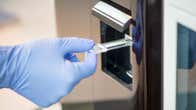
The WAVEsystem’s microfluidics cartridge, WAVEchip, supports rapid, non-clog analysis of analytes even in very complex matrices. Crude samples, pathogenic assays, harsh solvents and large particles (up to 1000 nm) can be analyzed with ease, something that can usually only be achieved with plate-based assays.
The innovative design includes all microfluidics pathways on one disposable cartridge and is simply loaded into the system for automated label free characterization. The cartridge design allows ultra-fast transition times of 150 ms for reliable determination of off-rates of 10 s-1, enabling the kinetic study of weakly binding fragments.
For more information on the WAVEsystem and its associated technology – download our WAVEsystem brochure
By observing the analyte-ligand interactions in real-time, using GCI technology, the kinetic association rate constant (ka) and kinetic dissociation rate constant (kd) can be established. Using these constants, the equilibrium dissociation constant (kD) can be easily computed. kD gives the analyte concentration when half of the ligands are occupied and this reveals the affinity of the interaction.
This information is displayed on the sensorgram and shows the binding response over time.
Typical sensorgram, showing the baseline, association, dissociation and return to baseline through regeneration.
Once the buffer is in a steady flow to create a baseline, the analyte is added and the association phase is measured (from t=0). As the analyte binds to the ligand, the refractive index of the medium next to the sensor surface increases and the signal magnifies, allowing the WAVEcontrol automated software to calculate the ka of the interaction. The steady/equilibrium state is reached once the association and dissociation rates are equal and then the running buffer is added to determine kd. Together these results give a full characterization of the interaction between the analyte and the ligand in real-time, without the need for follow-on manipulation of the assay components.
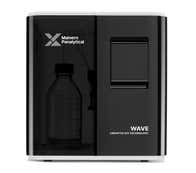
For more information on the WAVEsystem and its associated technology, download our WAVEsystem brochure.
With its high sensitivity, automated operation, high throughput analysis and versatility for a wide range of complex matrices and sample types, the WAVEsystem is well-suited to many applications:
waveRAPID is a high throughput quantification technique, characterizing large numbers of analytes, in a short period, within a wide range of properties, using repeated analyte pulses of increasing duration (RAPID). Since this robust method requires only a short analyte-ligand contact time, kinetic information can be gathered even from challenging analytes, such as non-specific binding or aggregation samples.
For high-affinity analytes or other tight interactions with slow dissociation, regeneration-free kinetics enables the full kinetic profile to be analyzed. This method is also useful when suitable regeneration conditions can’t be found.
The WAVEsystem enables the identification and ranking of molecules that bind to particular targets from large molecular libraries. Hits are identified based on their responses which, in turn, are linked to molecular weight and the affinity of the analyte to the target ligand. The WAVEcontrol software corrects and normalizes the responses so that identified hit compounds can be ranked according to affinity.
Due to its high sensitivity, the WAVEsystem can qualitatively assess the specificity of molecular interactions, ensuring no false positives through non-specific interactions. The binding specificity can be used to:
Biologically active and inactive species can be distinguished, even in non-purified samples, such as food, cell extracts and serum, using the non-clog features of the WAVEchip. This makes antibody analysis much easier since purification is not required following the cell culture stage and the antibody can be analyzed directly from the supernatant.
Enhancement can then fully determine antibody isotopes, without separation or washing steps. With the continuous monitoring capability of GCI, throughout the whole biosensor length, even fast-associating, low-affinity interactions can be recorded and analyzed for the deepest levels of characterization.
With the WAVEsystem, GCI sensitivity combines with automated analytical control and innovative microfluidic technology to provide a novel, optic biosensor platform for complete, real-time, label-free binding kinetics.
Even the most challenging analytes can be quickly and easily analyzed to deliver deep insight into previously undetectable interactions.
Contact our expert team for advice on how the WAVEsystem can help you drive effective label-free characterization.
Contact the team
The Kinetics Guide | Techniques, applications, experimental design & data analysis with Creoptix. Download now
Download now