NanoSight Pro
Analyseurs de taille de particules NTA

Low-Volume NTA with 10-20 µL - the NanoSight Pro One Drop Method

Some nanoparticle samples are simply too valuable to waste.
Whether you are working with precious biological material, an early-stage formulation or nanoparticles that are difficult to produce in volume, the amount of sample available can place practical limits on your analysis. Standard NanoSight Pro flow-based measurements typically require a minimum sample volume of 250 µL. The One Drop Method provides an alternative when your entire sample is measured in microlitres.
Using just 10 to 20 µL, the NanoSight Pro One Drop Method enables high-quality Nanoparticle Tracking Analysis (NTA) without compromising NTA data quality, provided the sample is prepared at the appropriate concentration.
|
STANDARD FLOW-BASED NTA Minimum sample volume:
|
ONE DROP METHOD Sample volume: 10-20 µL
|
Less sample. More possibility. The same confidence in your NTA data.
Explore NanoSight Pro | Discover Nanoparticle Tracking Analysis
The One Drop Method is an alternative sample-loading approach designed specifically for situations where only a very small volume of sample is available.
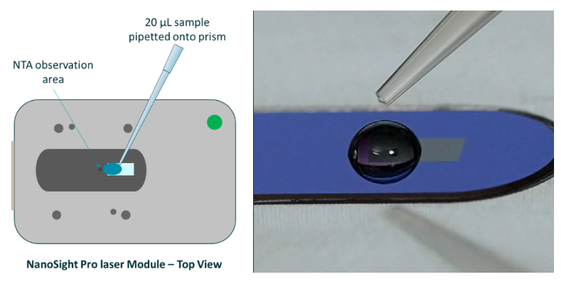
Instead of connecting the sample to the NanoSight Pro fluidics system, 10 to 20 µL of sample is pipetted directly onto the laser module prism. The Low Volume Flow Cell (LVFC) is then positioned over the prism, spreading the sample across the prism and scatter area.
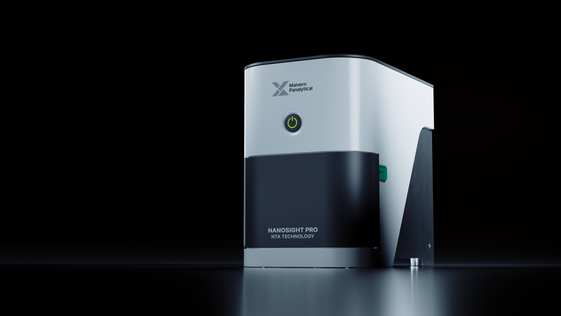
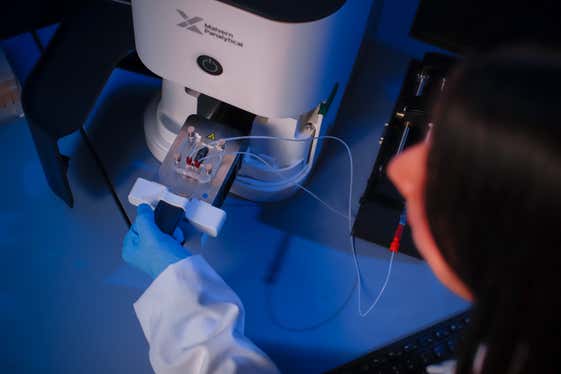
The laser module is inserted into NanoSight Pro and the sample is analysed in static mode using NS Xplorer software. It is a simple change to the way the sample is loaded, but for scientists working with precious or volume-limited materials, it can make a significant difference to what can be measured.
For standard flow-based NanoSight Pro measurements, the final method guide specifies a minimum volume of 250 µL. With the One Drop Method, the recommended working volume is 10 to 20 µL. At the lower end of that range, this represents up to a 25-fold reduction in minimum sample volume.
For laboratories where sample availability is one of the limiting factors in an experiment, reducing the amount required for NTA can help preserve valuable material for subsequent measurements, complementary analytical techniques or further experimentation.
When sample is abundant, volume may be a secondary consideration. When it is scarce, sample consumption can become part of the experimental decision itself.
The One Drop Method is designed for these situations. It can be particularly valuable for volume-limited or hard-to-replace samples, early-stage research and proof-of-concept studies. By reducing the required sample volume, researchers can gain nanoparticle size and concentration information while preserving more material for the next stage of their work.
When obtaining or producing your sample requires considerable time, cost or effort, every microlitre has value. The One Drop Method enables NTA measurements without committing the volume required by a conventional flow-based measurement.
Limited sample availability is common during early-stage research and formulation work. Lower-volume analysis can make NTA accessible at points in the workflow where committing larger sample volumes may otherwise be impractical.
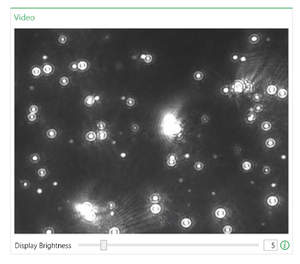
The method is designed to provide NTA data quality comparable to standard measurements when the sample is correctly prepared and loaded. Before analysis, users confirm that particles are visible and that image quality is comparable with a standard NTA measurement.
The One Drop Method uses standard NanoSight Pro hardware and requires no additional consumables. Measurements are conducted in static mode and the method is suitable for scatter-mode applications.
The sample is first prepared at an appropriate NanoSight Pro NTA concentration of 10⁶ to 10⁹ particles/mL. A calibrated pipette is then used to place 10 to 20 µL directly onto the laser module prism.
The droplet should form a stable bead on the prism. The flow cell is carefully lowered vertically into position and secured diagonally using the four sprung securing screws. As it is tightened, the sample spreads to cover the prism and scatter area.
Once the laser module has been inserted into NanoSight Pro, NS Xplorer is used to confirm particle visibility and image quality before the light-scatter measurement is performed. Because the fluidics are not connected, Flow Control is set to Static and Advance Sample to Off.
Reducing sample volume does not change what makes NTA valuable. Nanoparticle Tracking Analysis uses light scattering and Brownian motion to analyse particles in liquid suspension on a particle-by-particle basis. This page should link naturally to Malvern Panalytical's core NTA technology page for the deeper technology explanation.
With NanoSight Pro, low-volume analysis can provide particle size and concentration information while helping researchers conserve scarce material.
The One Drop Method is designed primarily for scatter-mode analysis where sample volume is limited. Consider it when your sample is difficult to produce, expensive, precious, available only in microlitre quantities, or when preserving material for additional analytical techniques is important.
The development guide also provides an important fluorescence qualification. The method can be used with highly photostable fluorescent samples, but standard flow-based loading is strongly recommended for fluorescence measurements to minimise photobleaching effects.
The value of conserving sample extends across nanoparticle research, but it can become particularly important in biologics and pharmaceutical development where the material being characterised may be difficult to produce at an early stage.
Standard flow-based NanoSight Pro measurements typically require a minimum sample volume of 250 µL. The One Drop Method enables analysis using 10 to 20 µL, provided the sample is prepared at an appropriate concentration.
The final method guide specifies an optimal NanoSight Pro NTA concentration range of 10⁶ to 10⁹ particles/mL.
No. The method uses standard NanoSight Pro hardware and does not require additional consumables.
No. The One Drop Method is a static measurement. Fluidics are not connected, so Flow Control is set to Static and Advance Sample is switched off.
The development guide reports that volumes as low as 5 µL are possible, but require greater skill to load and seal reliably. For customer-facing guidance, 10 to 20 µL should remain the recommended range because it is the range specified in the final method document.
The development guide states that the method can be used with highly photostable fluorescent samples. However, standard flow-based loading is strongly recommended for fluorescence measurements to minimise photobleaching.
The development guide indicates that this can result from incorrect droplet placement or uneven spreading beneath the LVFC, particularly near the laser entry region.
Analyseurs de taille de particules NTA
Limited sample should not have to mean limited insight.
The NanoSight Pro One Drop Method gives researchers a practical route to nanoparticle size and concentration measurements when only microlitre quantities of material are available. Using 10 to 20 µL, existing NanoSight Pro hardware and a simple static measurement workflow extends the flexibility of NTA to samples where preserving material matters.
Whether you are investigating precious biological samples, developing new formulations or working with hard-to-produce nanoparticles, the One Drop Method can help you get more analytical value from the sample you have.
Less sample. Same confidence. Smarter measurement.
Ressources