
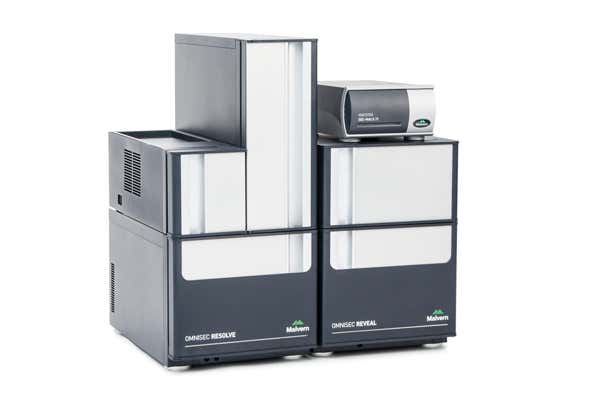
OMNISEC REVEAL
The ultimate in integrated advanced detection for GPC/SEC and UPLC/UHPLC
Molecular weight, intrinsic viscosity and numerous other parameters can be measured with OMNISEC REVEAL, the world’s most advanced integrated GPC/SEC multi-detector available. It can be added to any existing conventional GPC/SEC system or used in conjunction with OMNISEC RESOLVE to form a complete GPC/SEC solution, to offer comprehensive molecular characterization of synthetic and natural polymers, as well as proteins. The system is now also compatible with UPLC/UHPLC systems such as Waters ACQUITY APC™ for faster and more detailed polymer analysis.
Overview
OMNISEC REVEAL can be used to relate a polymer’s molecular properties to its bulk characteristics in a wide range of applications, from the packaging and paint industries to the manufacturing of food additives and pharmaceuticals. Its protein characterization capabilities can be used to study the effects of oligomerization, aggregation and conjugation on activity and efficacy in academic research and biopharmaceutical development.
With OMNISEC REVEAL you can:
- Understand and control product performance of polymers, polysaccharides and proteins by measuring absolute molecular weight, intrinsic viscosity, hydrodynamic radius, Mark-Houwink parameters, radius of gyration, branching, and co-polymer composition.
- Measure molecular weight as low as 200 Da or injection masses as low as 100 ng for characterization of samples which were previously unmeasurable using advanced detection.
- Improve separations and result accuracy with the column oven and temperature-controlled integrated detector compartment that minimizes inter-detector tubing
- Distinguish chemical changes by measuring absorbance across the full UV/Vis spectrum using the photodiode array
- Undertake a wide range of applications in different solvents thanks to Teflon and 316 stainless steel construction throughout
- Reduce instrument downtime and service costs with a novel self-balancing viscometer design with user-exchangeable capillaries
- Boost lab productivity with a novel self-balancing viscometer design with user-exchangeable capillaries.
How it works
GPC/SEC is a two-step analytical process that involves separating a sample on the basis of its size and then analyzing the resulting fractions. The technique delivers molecular weight, molecular size and structural information, all of which define the performance of many industrially important materials. Coupling the efficient sample separation of OMNISEC RESOLVE with the fully optimized, multi-detector, information-rich analysis delivered by OMNISEC REVEAL, Malvern has produced a market-leading solution for researchers and formulators developing novel natural and synthetic polymers, pharmaceutical and biopharmaceutical products and foods.
The RI and UV detectors give information about the concentration of the components in the sample. The light scattering detectors respond to the intensity of light scattered by the sample which is related to molecular weight and also allows Rg of large molecules to be calculated. The viscometer measures the changing solution viscosity to calculate the intrinsic viscosity of the sample which is a measure of structure. By combining the molecular weight and intrinsic viscosity data, the hydrodynamic diameter of the sample can also be calculated along with structural information via the Mark-Houwink plot.
Specification
System
- Dimensions (W, D, H):
- 420, 640, 600 mm
- Weight:
- 40 kg
- Detector temperature range:
- 20 - 65 °C
- Software:
- OMNISEC software v10 (or later)
- Data acquisition rate:
- 100 Hz
- Patents:
US20140060162A1 & EP2619543B1 "Modular capillary bridge viscometer"
US20140144214A1 & EP2619544A1 "Automatically balanced capillary bridge viscometer"
Detector 1
- Detector:
- Light scattering
- Measurement principle:
- RALS 90° angle, LALS 7° angle
- Light source:
- 50 mW, 640 nm laser
- Cell volume:
- 18 µL
- Dynamic range:
- 2500 mV
- Baseline noise:
- <0.1 mV
- Baseline drift:
- <0.2 mV/hr
Detector 2
- Detector:
- Differential refractive index
- Measurement principle:
- Deflection
- Cell volume:
- 12 µL
- Dynamic range:
- ±2.5 x 10⁻⁴ RIU
- Baseline noise:
- <10-7 RIU
- Baseline drift:
- <3 x 10⁻⁷ RIU/hr
Detector 3
- Detector:
- Viscometer
- Measurement principle:
- 4-capillary Wheatstone bridge with self-balancing mechanism and user-exchangeable capillaries
- Detector volume:
- 17 µL/capillary
- Differential pressure dynamic range:
- ±2500 Pa
- Differential pressure baseline noise:
- 0.3 Pa
- Inlet pressure dynamic range:
- 100 kPa
- Inlet pressure baseline noise:
- 0.01 kPa
- Baseline drift:
- <0.2 kPa/hr
Detector 4
- Detector:
- Diode-array-based UV/Vis spectrometer
- Wavelength:
- 190 - 900 nm
- Number of wavelengths:
- 1024
- Wavelength accuracy:
- <1 nm
- Wavelength resolution:
- 0.6 nm
- Cell volume:
- 7.5 µL
- Path length:
- 10 mm
- Baseline noise:
- 2 x 10⁻⁵ AU
- Baseline drift:
- 5 x 10⁻⁴ AU/hr
Measurement type 1
- Measurement type:
- Absolute molecular weight
- Measurement range:
- 200 - >107 g/mol
- Minimum quantifiable mass:
- 100 ng of 100kDa molecular weight polystyrene in THF
- Measurement principle:
- Light scattering (LALS or RALS)
Measurement type 2
- Measurement type:
- Intrinsic viscosity
- Minimum quantifiable mass:
- 1 µg of 100kDa molecular weight polystyrene in THF
- Measurement principle:
- 4-capillary Wheatstone bridge
Measurement type 3
- Measurement type:
- Concentration
- Minimum quantifiable mass:
- 100 ng of 100kDa molecular weight polystyrene in THF
- Measurement principle:
- Differential refractive index detection
Operating environment
- Temperature:
- 15 °C - 30 °C
Software
- Minimum computer specification:
- Windows 7 Professional 64 bit, 4th Gen Intel(R) Core I7 Processor (Quad Core HT, 3.4 GHz Turbo, w/ HD Graphics), 8 GB 1600 MHz DDR3 memory, 500 GB 3.5 inch SATA (7200 RPM) HDD, Full-HD monitor