X-ray reflectometry (XRR)
Analysis of thin films, surfaces and interfaces


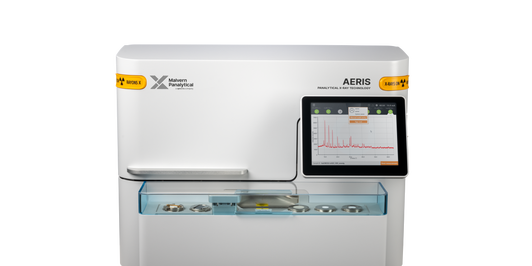
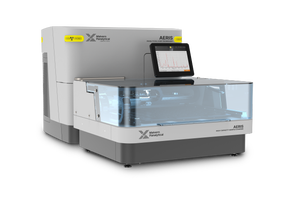
Aeris meets X-ray Reflectometry: measure thin film and surface roughness with ease. Find out more
Find out moreAnalysis of thin films, surfaces and interfaces
X-ray reflectometry (XRR) is an analytical technique used to investigate thin layered structures, surfaces and interfaces using the total external reflection of X-rays.
Understanding a thin film's thickness can give key insights into a material’s performance. Gate oxides are a key component when developing semiconductors. Present as a thin, insulating layer, typically just a few nanometres, if they are too thin then increased current can leak, leading to overheating. Too thick and switching will be slower, leading to slow performance. XRR can also provide key insights when looking at coatings in magnetic, optical, and energy storage devices, among others.
In reflectometry experiments, the X-ray reflection of a sample is measured around the critical angle. This occurs around grazing incidence angles.
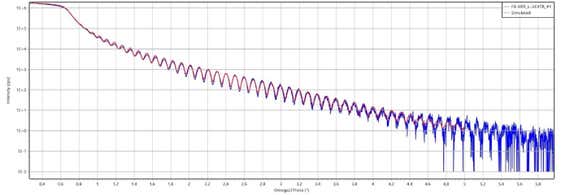
Below the critical angle of total external reflection, X-rays penetrate only a few nanometres into the sample. Above this angle the penetration depth increases rapidly. At every interface where the electron density changes, a part of the X-ray beam is reflected. The interference of these partially reflected X-ray beams creates the oscillation pattern observed in reflectivity experiments.
From these reflectivity curves, layer parameters such as thickness and density, interface and surface roughness can be determined, regardless of the crystallinity of each layer (single crystal, polycrystalline or amorphous).
Figure 1: XRR fit of data extracted from a frame-based 1D measurement on Aeris. The blue curve shows experimental data, while the red curve shows the fitted profile for a 50 nm iridium layer.
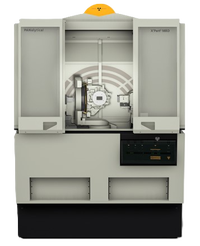
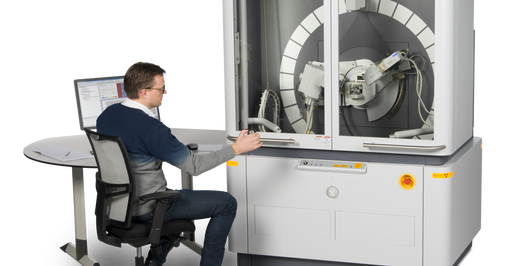
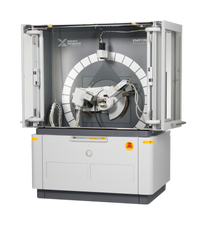
Reflectometry measurements can be performed on both the Aeris (thicknesses of 1-200 nm) and Empyrean (thicknesses of 1-1000 nm) XRD systems.
Reflectometry data can be analyzed with a choice of automatic fitting procedures, allowing for quick and straightforward analysis within the AMASS software.
The intelligent diffractometer
Compact benchtop X-ray diffractometers
Versatile research and development XRD system