AccuPore
Precise through-pore characterization made simple
Capillary flow porometry for precise, reliable and direct bubble point and through pore size measurements across the widest sample range. Flexible and smart design with no complex setup.

Precise through-pore characterization made simple
Capillary flow porometry for precise, reliable and direct bubble point and through pore size measurements across the widest sample range. Flexible and smart design with no complex setup.
By measuring true through pores directly, without curve fitting or model assumptions, AccuPore, a Micromeritics technology, delivers reproducible pore size distributions, accurate bubble point values, and meaningful mean flow pore sizes that translate directly to real-world performance in the right timescales.
Its flexible pressure ramp and step modes allow researchers to rapidly screen new materials during development, while the same robust, standardized measurements ensure consistent, audit-ready quality control of membranes, filters, and separators in routine manufacturing environments.
≤0.1% for known materials, ≤1% for largest pore and pore size, 2x more data points than the closest competitor and ASTM-compliant methodology ensures defensible data.
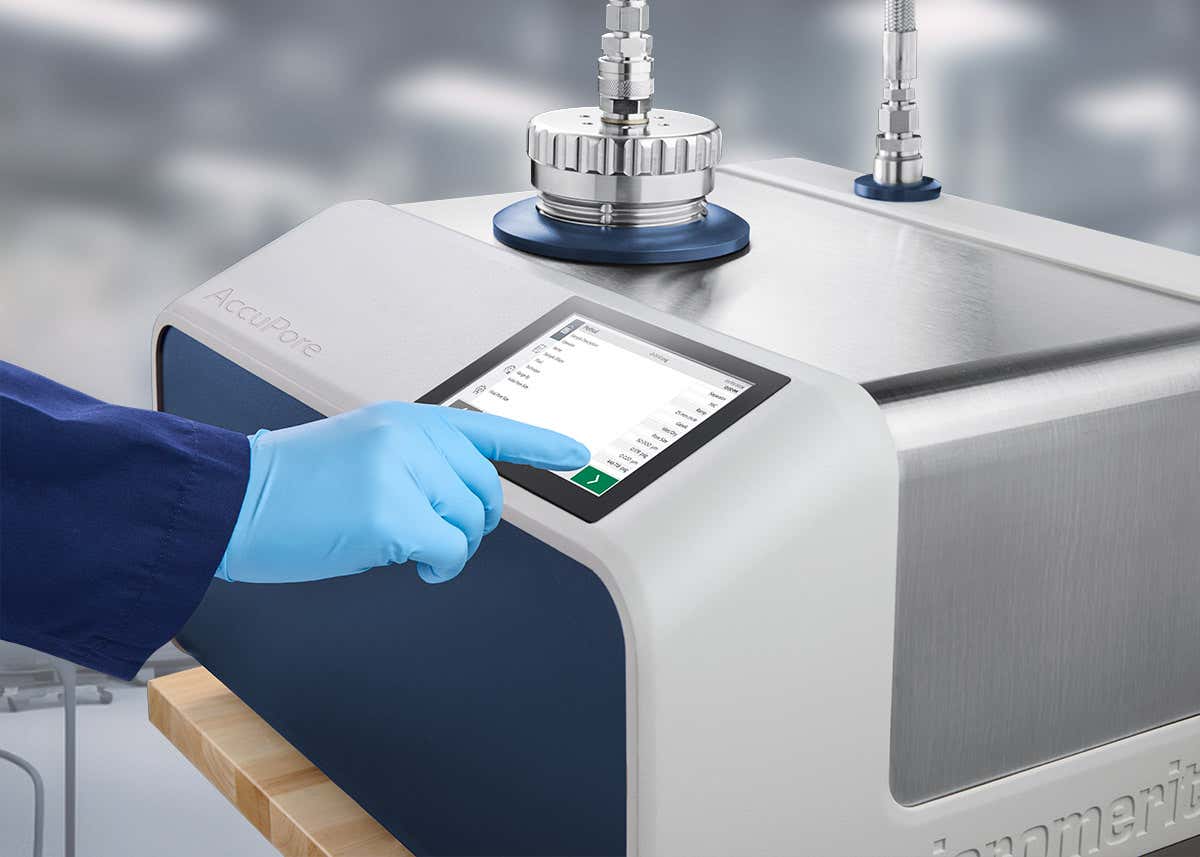
Built-in methods simplify setup and method development, and the intuitive Breeze™ interface makes it easy to get precise, operator-independent results – no curve fitting or complex image processing. Easy method transfer from R&D to QC and 100% remote operation streamlines your workflow.
Sample preparation takes <30 seconds, and Ramp Mode delivers up to 10× quicker scans – so you can accelerate full profiles when speed matters most.
Smart-automated gas source selection saves up to $90,000 (1,500 gas tanks) per year for labs running >50 samples/week, and the 2-in-1 ramp and step system saves costs on equipment, servicing, and consumables. Simplified operation cuts training and overhead costs.

Optimize the rate of ion transport and physical separation to ensure device safety. Precision sample supports and advanced pressure control enable accurate measurements up to high pressure for small pores and thin membranes.
Predict and ensure size-based selectivity and mass-transfer rate by optimizing the number and size of pores.
Often characterized by a broad distribution of pore sizes due to their production methods. These are common choices for filtration media. In-plane porosity and irregular pore shapes make steady flow determination of bubble point especially important.
Preferred for thermal, physical, and chemical resistance, these materials often have highly porous structures. The three-dimensional porosity of these materials makes it especially important to measurement porosity in the direction of intended flow.
Measure 13mm, 25mm, and 47mm-diameter samples within the same sample chamber, with no need for fixture swaps or recalibration. From delicate membranes to high strength separators, R&D to QC, AccuPore handles it all without needing expert-level setup or method development.
Versatility
| Technology | Capillary flow porometry
ASTM F316 |
|---|---|
| Analysis method | Pressure ramp
Pressure step |
| Pore size range | 0.013 µm to 500 µm |
| Data resolution | >1000 points, 20 Hz processing |
| Sample size | 13 mm / 25 mm / 47 mm |
| Maximum pressure | 500 psi (35 bar) |
| Maximum flow rate | 200 L/min |
| Analysis gas supply | Air or N2 |
AccuPore’s pressure flow curves reflect actual pore architecture with >1000 data points per run, enabling true physical interpretation without curve fitting artifacts.
Precision
Designed for the AccuPore

Wetting fluids for the AccuPore

Connect your AccuPore

Protect your team and your instrument’s uptime with our AccuPore’s unrivalled safety and support features. AccuPore is the only system offering full UL/CSA certification, ensuring risk-free operation, and you’ll also have access to Malvern Panalytical’s unique global network of service and support.
Our support network
Porometry and porosimetry are two different methods for analyzing porous materials. Porometry identifies through-pore diameters and flow traits like bubble point and permeability, whereas porosimetry (particularly mercury intrusion) measures total pore volume, density, and the size distribution of all connected pores.
Any industry that needs to control, measure, or validate through-pore size distribution, flow, and bubble pointy can benefit from AccuPore—especially where product safety, performance, and consistency are critical.
Porosity and pore size distribution describe different but complementary properties of a porous material. Porosity refers to the total amount of empty space within the material, usually expressed as a percentage, indicating how much fluid or gas it can hold overall. In contrast, pore size distribution describes the range and frequency of pore sizes present, showing whether the material has mostly small, large, or a mix of pores and how they are spread. While porosity tells you how much void space exists, pore size distribution tells you how that space is structured, which is crucial for determining how fluids flow through the material and what particle sizes can be filtered.
AccuPore sets the standard for through-pore porosity analysis while streamlining your workflow, offering: