


Overview
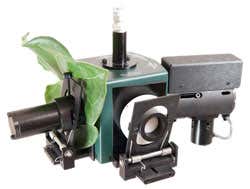
The RTS-3ZC Integrating Sphere features a 13º/D geometry to allow near normal incidence at 13º, and diffuse collection via the instrument’s fiber optic bundle. The interior of the integrating sphere is made of Zenith diffuse polymer material, a solid, machined form of PTFE. Zenith® is a highly reflective (>95%) and Lambertian reflector over the broad spectral range of 350-2500 nm, which provides maximum efficiency and optical performance. A specially designed collimated tungsten light source, included with the sphere, delivers close to solar irradiance levels at the sample.
The base sphere assembly includes six ports designed to accept supplied sample holders, light source assembly, fiber optic adapter, light trap, and port plugs. Two nominal 99% Zenith® diffuse reference standards, one calibrated and one uncalibrated, are included with the assembly for absolute or relative spectral reflectance measurements.
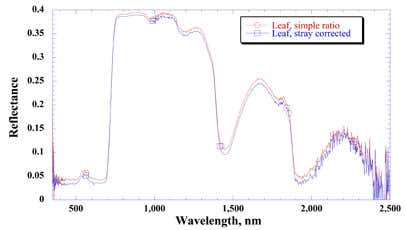
Shown above: Reflectance spectrum of a leaf with (blue curve, squares) and without (red curve, circles) stray light correction.
Configurable in a number of different ways, with very minimal set up, the sphere allows for rapid analysis of several important quantities:
- 13º/D Total Hemispherical Reflectance (Specular Included)
- Comparison Method and Substitution Method
- 13º/D Hemispherical (Specular Excluded) Reflectance Factor
- Normal Hemispherical Transmittance
The sphere can also be conveniently mounted on a tripod or hand carried. The RTS-3ZC Integrating Sphere is packaged in a rugged, water-tight field portable carrying case, which holds the sphere assembly and all components securely.
Use of Integrating Spheres in Field Radiometry
Radiation balance and plant canopy modeling studies often require measurement of hemispherical reflectance and transmittance values of real world samples. For many of these studies, the use of reflectance values measured using directional illumination/directional viewing geometries can lead to erroneous results.
The integrating sphere is ideally suited for these measurements because it collects all the radiation reflected from, or transmitted through, a sample. With an external integrating sphere (sample is external to the sphere) the sphere collects reflected light from a sample, or light transmitted through a sample, and spreads the energy over the entire surface area of the sphere in a very even distribution. A detector then responds to a portion of the sphere wall energy to derive a meaningful value about the average hemispherical reflectance of the sample. Using the principles of an integrating sphere, the reflectance or transmittance of a sample can be derived using the ratio between a known reference and unknown sample.
Spheres have been used in this way since the early twentieth century, and methods for measuring reflectance with spheres are well documented within US and International standards committees. In fact, if calibrated standards with known reflectance values are used as references to the sample measurements, the results can also be considered absolutely traceable reflectance values.