

Looking for more information?
To request a quote, more information or download a brochure select an option below.
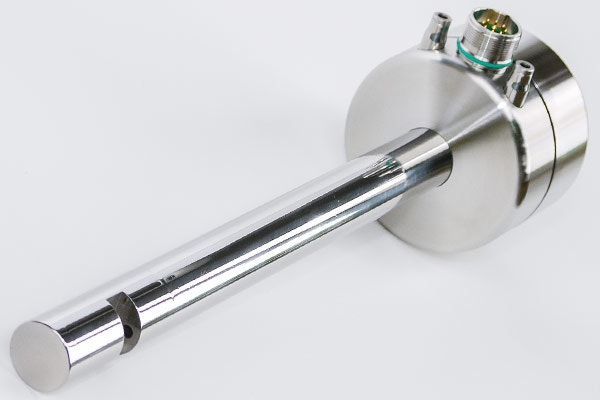
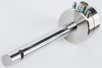
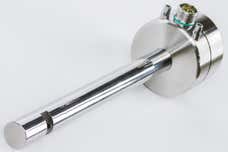
Specifically designed for the pharmaceutical and food industries, the Parsum IPP 80-P is an intrinsically safe probe delivering real-time particle size and particle velocity measurements for solid particles in the range from 50µm up to 6mm in size.
It's simple, dustproof, and waterproof probe design enables direct monitoring of fluidized bed and high shear mixing and granulation processes.
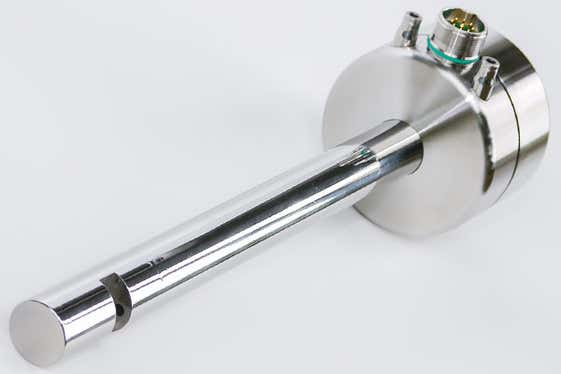
Compact, lightweight and easy to install for rapid integration into new and existing processing plants
Characterizes particles in the range from 50 µm to 6mm, travelling at up to 50 m/s
Reproducible measurement at high solids loadings enabling real time fluidized bed monitoring
Real-time measurement and feedback via comprehensive, customizable software
Measurements can be carried out without the need for sample extraction
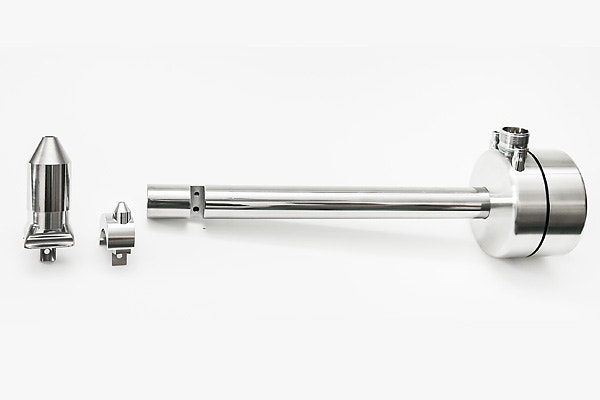
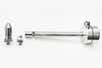
A range of accessories enables measurements to be made for abrasive, sticky and cohesive particles
Complies with ATEX requirements for operation within Zones 0 and 20
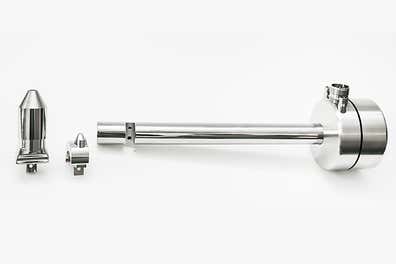
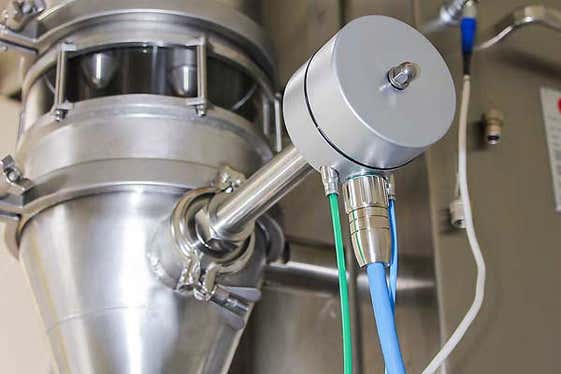
The Parsum IPP 80-P is used in food and pharmaceutical applications for endpoint detection in batch granulation process, and for real time monitoring of continuous manufacturing processes. It is applied in unit operations such as grinding, agglomeration, granulation, coating and sieving.
This probe has been designed to measure the particle size and size distribution of powders, pellets or granules in pharmaceutical and food processes. It is a valuable PAT tool that can be easily installed in areas where cleanliness, cleanability and hygiene are important requirements.
The probe can be used for conventional batch processes or for monitoring continuous production processes and includes enhanced self-diagnostic features. It is ATEX certified for Zone 0/20 operation.
| Measurement range | 50µm to 6mm |
|---|---|
| Velocity measurement range | 0.01 - 50m/s |
| Concentration range | Up to 30v%
Sample and particle property dependent |
| Materials in contact with the dispersant, additives and sample | 316L stainless steel (DIN1.4435, 1.4404)
Sapphire windows |
| Dimensions | 101mm x 85mm x 65mm |
|---|
| Length | 282mm |
|---|---|
| Diameter | 25mm |
| Temperature (operating) | Up to 100 °C |
|---|---|
| Temperature range | 10 °C - 60 °C |
| Pressure | Up to 15 bar |
| Humidity | 35% - 80% non-condensing |
| Enclosure rating | IP 65 |
| Explosion Protection | ATEX certified for Zone 0/20 |
| Power | 100-240 V, 50-60 Hz |
| Light source | 670 nm |
|---|---|
| Laser safety | Class 1 |
Inline disperser for fine particle processes

Inline dispersion for coarse particles and high solids loadings.

At-line particle sizing for process applications.

Efficient data transfer from Parsum probe to centralized control system.

The Parsum probe uses the measurement principle of spatial filter velocimetry. This is a number-based, chord length sizing method that collects data for individual particles to obtain a particle size distribution and velocity distribution.
Particles falling through the Parsum probe measurement zone block the light emitted from a laser light source. The resulting shadow is detected using a linear detector array made up of optical fibers. Particle velocity is calculated by tracking movement of the particle shadow across sequential detector elements. Particle size is determined by measuring the length of time the particle blocks a single optical fiber.
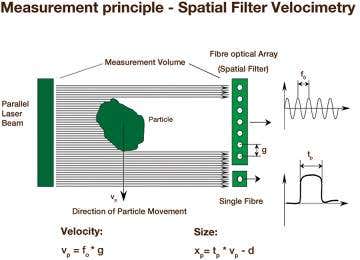
Measuring a large number of particles generates statistically valid results from which various size parameters and volume-based distributions are derived.
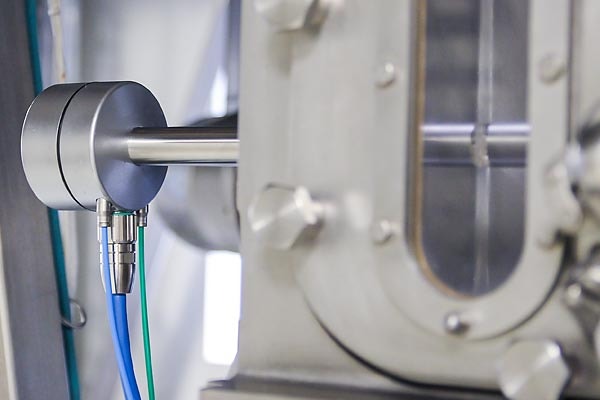
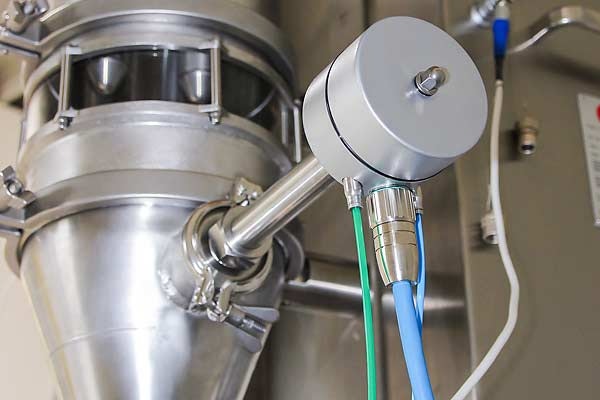
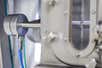
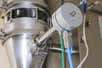
The Parsum probe is installed directly into the process line or vessel. Although no sample preparation is required, an internal compressed air supply can be used to disperse agglomerates, to keep the flow channel and optics clear of material and to enable measurement at high solids loadings.
Information is transferred from the measurement zone to the electronic housing of the probe via fiber optic cable, increasing instrument robustness. A direct cable connection of up to 100m in length can then be used between the probe and the computer, enabling operation of the system from a safe area. Results can be reported to a PCL via 4-20mA signals or using OPC or TCP servers to a plant control system.
| Title | Version | Date | Download |
|---|---|---|---|
| {{ row.title }} | {{ row.softwareVersion }} | {{ row.date }} | Download |
Sorry, no manuals are available for this product
| Title | Version | Date | Download |
|---|---|---|---|
| {{ row.title }} | {{ row.softwareVersion }} | {{ row.date }} | Download |
Sorry, no software downloads are available for this product
To assure that your instrument remains in top condition and performs on the highest level, Malvern Panalytical offers a wide range of services. Our expertise and support services assure an optimal functioning of your instrument.
Service for a lifetime
Adding value to your processes
Designed for the pharmaceutical and food industries. Cable-free, rapid integration. Directly monitor and control your processes for improved QC.