
Looking for more information?
To request a quote, more information or download a brochure select an option below.
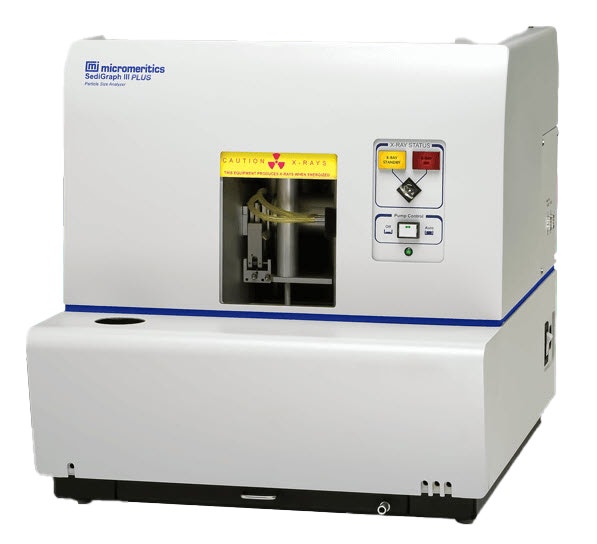
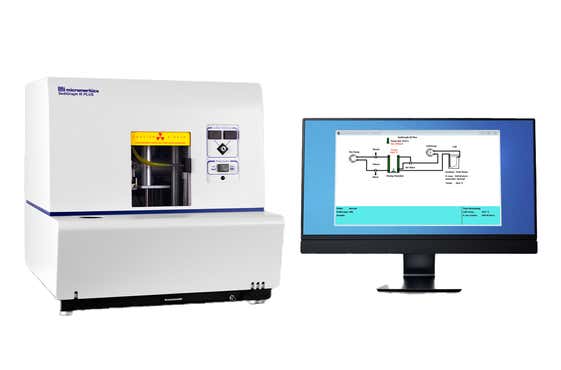
The SediGraph, a Micromeritics technology, continues to be utilized for particle size analysis in many laboratories throughout the world. Whether in a rugged production environment or a controlled laboratory setting, the SediGraph continues to produce accurate results with superior reliability.
Particle size distribution is measured using the sedimentation method. Particle mass is measured directly via X-ray absorption.
By measuring the rate at which particles fall under gravity through a liquid having known properties as described by Stokes’ law, the SediGraph determines the equivalent spherical diameter of particles ranging from 0.1 to 300 µm.
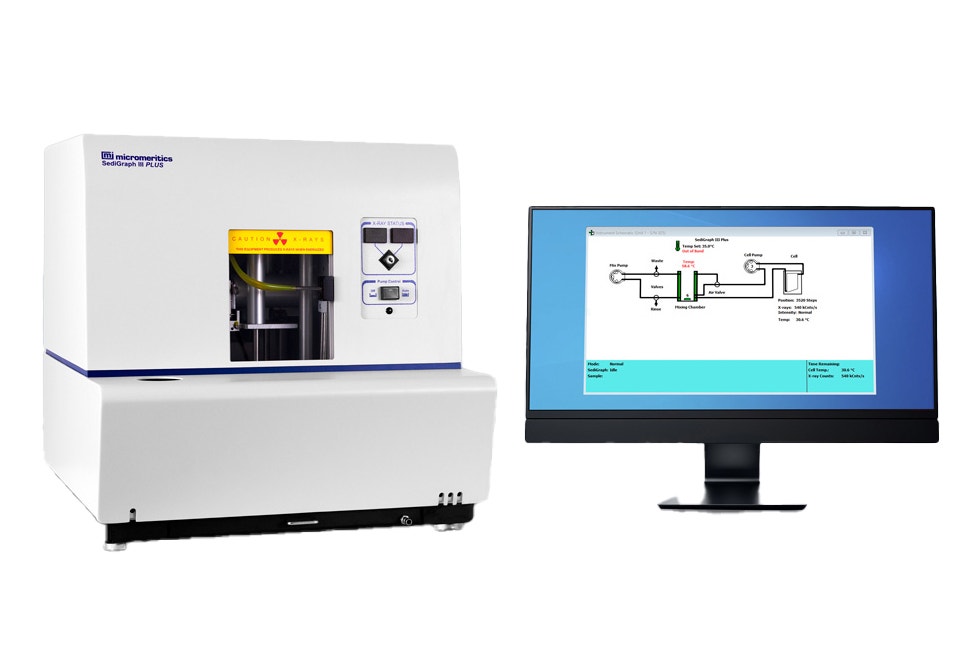
The new generation SediGraph III Plus combines this proven technique with new technology to deliver reproducible and highly accurate particle size information, completing most analyses in minutes.
The size range of particles and the distribution of mass in each size class strongly affect the ability to sinter a ceramic powder and its forming properties as well as the pore size distribution in the finished product. Particle size distribution information helps to determine curing and bonding procedures, control pore structure, ensure adequate green body strength, and produce a final product of desired strength, texture, appearance, and density.
Monitor and control composition of API’s and excipients by measurement of product density. Differences in polymorphic, hydrated, and amorphous forms of products, as well as purity, can be detected through density measurements.
Grain Size affects the moisture-holding capacity of soil, drainage rate, and the soil’s ability to hold nutrients. Grain size is directly related to transport of sediment.
The appearance, application, and packaging of cosmetics are influenced by the particle size distribution of base powders, such as talc, and the pigments used for coloring.
Particle size alone can affect the tinting strength of a color. As tinting strength goes up, the quantity of pigment needed to produce required color intensity goes down. The particle size affects the hiding power of the paints. Also the particle size distribution influences gloss, texture, color saturation and brightness.
Particle size affects the catalytic activity of a metal for structure-sensitive catalytic reactions.
Particle size of cement affects setting time and strength characteristics of finished concrete and cement.
Reactivity of materials is dependent upon exposed surface area and thus particle size distribution.
A properly balanced size distribution of abrasive grains and powders is a fundamental consideration whether the material is to be used in slurries, dry blasting, or bonded abrasive tools. Uniform particle size assures precise flow rates through blast machines and is a critical determination in media management when recycling the abrasive material.
| Particle size | 0.1 to 300 µm equivalent spherical diameter |
|---|---|
| Wetted materials | Stainless steel, Teflon® impregnated anodized aluminum, nickel plated aluminum, nylon, polypropylene, polystyrene, Tygon® and Pharmed® tubing, tungsten carbide, Ertalyte®, Viton®, Buna-n, and epoxy |
| Sample size | 50 mL of dispersed sample – precise concentration is not required |
| Suspending liquids | Any liquid compatible with sample cell materials and not highly absorptive of Xrays (typical liquids are water, glycols, mineral oils, SediSperse®, and alcohols) |
| Power Supply | 85 to 264 VAC, 47/63 Hz, 450 VA |
| Temperature (operating) | Ambient +10 to 40 °C, operating; -10 to 55°C, storing or shipping |
| Humidity | 20 to 80% (non-condensing) |
| Dimensions | Height: 52 cm (20.5 in.)
Width: 50.5 cm (20 in.)
Depth: 58 cm (23 in.)
Weight: 43 kg (95 lbs) |
The Micromeritics SediGraph determines particle size distributions and statistics, such as D10, D50, and D90, based on direct mass concentration detection. Basic and advanced reporting are available at the touch of a button. The SediGraph III Plus can be coupled with an optional MasterTech autosampler for continuous monitoring of a production process and have data pushed to a network or cloud for remote access.
Complete particle accountability assures that all of the introduced sample is accounted for, including fractions below 0.1 µm
Capability to merge data with that from other particle sizing methods, thus extending the range of reported data to 125,000 µm (125 mm), excellent for geological applications
Scanning the sedimentation cell from bottom to top allows accurate inventory of fast-settling particles while minimizing the time required to resolve the separation of fine particles
Fully automatic operation increases sample throughput and reduces operator involvement in addition to reducing the opportunity for human error
Temperature-controlled analyses assure that liquid properties remain constant throughout the analysis so you can be confident of accurate and reproducible results
Statistical process control (SPC) reports track the performance of your processes allowing immediate response to fluctuations
The Micromeritics SediGraph III Plus is equipped with a versatile, easy-to-use user interface that provides all of the convenient features you expect from a Windows-based program. These features include point-and-click menus, customizable reports with your laboratory logo graphic, editable graphs, cut-and-paste graphics and tables, data export features, and more.
Custom protocols help plan, launch, and control the analysis and ensure that subsequent analyses are all performed in the same manner, regardless of the skill of the operator. You can collect, organize, archive, and reduce raw data, and store standardized sample information and analysis conditions for easy access during later applications. Finished reports may be generated to screen, paper, or transferred in a variety of formats to storage devices.
Detailed analysis data for particles ranging from 300 to 0.1 µm are provided automatically by the SediGraph III Plus. Data collected from other particle size analyses ranging from 125,000 to 300 µm can be combined with SediGraph data, enabling effective reporting for particles ranging from 125,000 to 0.1 µm.
In addition to tabular data, different graphical analysis plot types are available including:
Plots can be overlaid to compare the results from different samples or to compare different plot types from the same sample. This allows you to compare analysis results to a standard. Plots can be rescaled to give you the ability to scrutinize your graphical data closely. A column has been added to the tables and to the x-axis selection in the graphs that reports size in Phi units, where Ф = -log2 (particle diameter in mm). Also, a column selection for settling velocity (cm/s) is available for tables. The x-axis of plots can be scaled in particle size or settling velocity.
| Title | Version | Date | Download |
|---|---|---|---|
| {{ row.title }} | {{ row.softwareVersion }} | {{ row.date }} | Download |
Sorry, no manuals are available for this product
| Title | Version | Date | Download |
|---|---|---|---|
| {{ row.title }} | {{ row.softwareVersion }} | {{ row.date }} | Download |
Sorry, no software downloads are available for this product
From rugged environments to laboratory settings, take your particle size analysis to the next level.
