Local structure
Determining atomic coordination and bond distances


Determining atomic coordination and bond distances
Understanding the local atomic arrangement around specific elements is essential for explaining material properties and performance.
In many materials, properties are governed by how atoms are locally arranged rather than by the average crystal structure alone. Subtle distortions, disorder, and nanoscale variations can strongly influence performance but remain invisible to diffraction techniques.
X-ray absorption spectroscopy (XAS), through extended X-ray absorption fine structure (EXAFS), enables direct measurement of the local atomic environment around a selected element. This provides quantitative insight into coordination numbers, bond distances, and structural disorder even in non-crystalline materials.
Use local atomic structure analysis when materials exhibit structural complexity beyond what an average crystal structure can describe.
Because XAS is element-specific, it allows the local structure around a selected element to be isolated even within complex or heterogeneous materials.
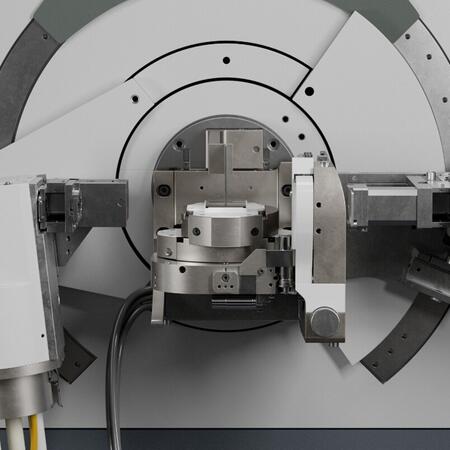
X-ray absorption spectroscopy (XAS) is now available in your lab with Empyrean XAS, our modular, future-proof materials characterization platform.
Typical scenarios include:
Key research questions include:
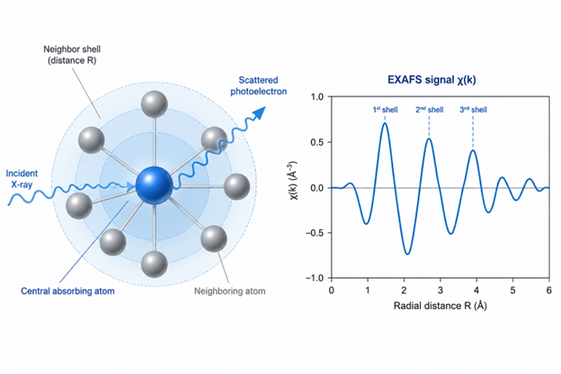
Local structure analysis is primarily based on extended X-ray absorption fine structure (EXAFS).
When X-rays are absorbed, photoelectrons are emitted from the absorbing atom and scatter from neighboring atoms. The interference between outgoing and scattered waves produces oscillations in the absorption spectrum.
Analysis of these oscillations provides:
This enables precise determination of the local atomic environment even in materials lacking long-range order.
Local atomic structure analysis can reveal the precise coordination environments, bond lengths, and structural distortions of active metal centres. Unlike bulk crystallographic methods, these approaches capture short-range order in catalyst materials in order to identify the true nature of active sites under realistic reaction conditions.
By correlating local structural features with catalytic activity, you can establish structure–property relationships that guide the rational design of more efficient catalysts for reactions such as CO₂ reduction, nitrogen fixation, and hydrocarbon conversion.
In battery research, probe the atomic-scale structural changes that occur during charge and discharge cycles, which are often invisible to conventional diffraction techniques due to the presence of amorphous phases, disorder, or nanoscale heterogeneity. With XAS, you can track subtle shifts in bond lengths, coordination environments, and phase transformations in electrode materials under operando conditions, providing a dynamic picture of how structure evolves with electrochemical state.
With these insights, you can pinpoint the origins of capacity fade, voltage hysteresis, and poor rate performance by linking local structural degradation mechanisms to macroscopic battery behavior, ultimately enabling the design of more stable, high-energy-density electrode and electrolyte materials.
XAS captures the true short-range atomic arrangements in nanoparticles, quantum dots, and two-dimensional materials, revealing how size, shape, and surface chemistry influence properties such as optical absorption, magnetic behavior, and mechanical strength.
By establishing direct links between local structural motifs and the functional properties of nanomaterials, you can move beyond trial-and-error synthesis toward the rational engineering of nanostructures with precisely tailored characteristics for applications in clean energy, drug delivery, and beyond.
XAFS allows researchers to precisely quantify how dopant species are accommodated within the lattice and how far their structural influence extends.
By correlating these local distortions with macroscopic functional responses, you can develop a mechanistic understanding of how to tune dopant identity, concentration, and distribution to optimize performance in a range of applications.
Local atomic structure analysis using EXAFS has historically been performed at synchrotron facilities, where high flux and tunable energy are required to resolve fine structural features. While these facilities provide powerful capabilities, access is often limited, and experiments must be carefully planned in advance.
Recent developments in X-ray source technology, optics, and detector sensitivity are now enabling EXAFS measurements in laboratory environments. This shift allows researchers to investigate local atomic structure more routinely, without the delays associated with external beamtime access.
Laboratory-based EXAFS makes it possible to carry out iterative studies, compare multiple samples under consistent conditions, and refine structural models more efficiently. This is particularly valuable when studying complex or evolving materials, where rapid feedback is essential to understanding structure–property relationships.
Add local chemical insight to your multipurpose X-ray platform
The Empyrean XAS platform brings EXAFS-based local structure analysis into a fully integrated laboratory system, combining it with high-performance diffraction and other X-ray techniques.
This enables researchers to directly correlate local atomic structure with long-range crystallographic information within a single experimental workflow. For example, coordination environments determined by EXAFS can be interpreted alongside phase composition and lattice parameters obtained from diffraction.
The modular design of the system supports flexible configuration for different sample types and experimental conditions, while maintaining consistent measurement geometry. This allows local structure analysis to become part of routine materials characterization, rather than a standalone, specialized experiment.
By integrating these capabilities, Empyrean supports a more complete understanding of materials, linking atomic-scale structure to bulk properties in a practical laboratory setting.