Oxidation state analysis
Tracking redox behavior and electronic structure


Tracking redox behavior and electronic structure
Understanding the oxidation state of elements in materials is essential for many advanced applications, including catalysis, energy storage, and functional materials. Subtle changes in oxidation state can strongly influence performance, stability, and reactivity.
X-ray absorption spectroscopy (XAS) provides a powerful, element-specific method to determine oxidation states and probe local chemical environments within complex materials. It enables researchers to study how electronic structure evolves under real conditions, offering insight that is often difficult to obtain with other techniques.
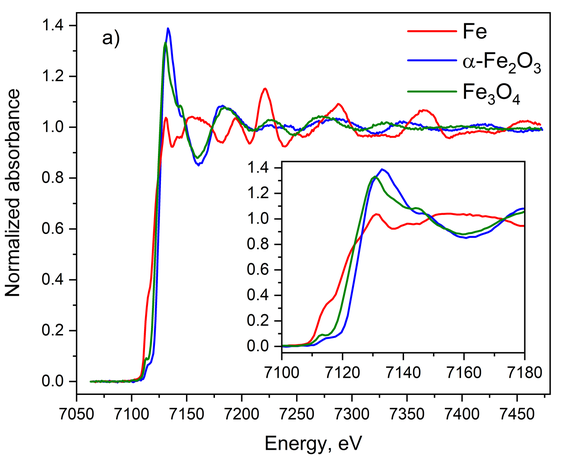
Many materials rely on subtle changes in oxidation state to control performance. These changes can occur during synthesis, processing, or operation.
XAS enables researchers to detect these changes with high sensitivity and element specificity, even in complex or heterogeneous systems.
Key research questions include:
Because XAS is element-specific, it isolates the signal of a chosen element even in multiphase or chemically complex materials.
Oxidation state analysis using XAS relies primarily on X-ray absorption near edge structure (XANES), which is highly sensitive to electronic structure.
When the incident X-ray energy is scanned across an element’s absorption edge:
By comparing measured spectra with reference materials or databases, the oxidation state and chemical environment of the absorbing element can be determined.
This analysis provides direct insight into redox processes, electronic structure, and chemical transformations within materials.
Oxidation state has a significant influence on catalytic activity and selectivity. XANES is a highly effective technique for in-situ and operando monitoring of catalyst materials and their changes.
In battery applications, oxidation states determine how energy is stored and released. XAS is the gold-standard for tracking redox processes in electrode materials during charge-discharge cycles.
XAS can be used to determine dopant oxidation states and charge compensation mechanisms in functional ceramics, which influence the performance of devices such as fuel cells, capacitors, and perovskites.
The bioavailability and toxicity of metals and organic compounds are dependent on their specific oxidation states. XAS is a key analytical technique for non-destructive analysis and chemical speciation of metals in soils, waters, and sediments.
XAS can be applied to investigate the electronic structure and surface chemistry in nanoscale systems, to better understand their chemical reactivity, catalytic activity, and stability.
Oxidation state analysis using XANES has traditionally relied on synchrotron radiation, where precise energy control and high spectral resolution enable sensitive detection of edge shifts and fine spectral features.
While highly effective, synchrotron-based measurements can limit the ability to study dynamic processes or perform routine screening due to restricted access and the need for scheduled experiments.
Advances in laboratory XAS instrumentation are now making it possible to perform oxidation state analysis in-house. This enables researchers to monitor redox processes more frequently, explore a wider range of experimental conditions, and respond more quickly to experimental findings.
Laboratory-based XANES is particularly valuable for studies involving iterative processes, such as catalyst optimization or battery material development, where repeated measurements are needed to track changes in chemical state.
Add local chemical insight to your multipurpose X-ray platform
The Empyrean XAS enables laboratory-based XANES measurements with the stability and energy control required for reliable oxidation state determination.
By integrating XAS with diffraction capabilities, the system allows researchers to correlate redox changes with structural evolution. For example, shifts in oxidation state can be directly linked to phase transformations or lattice changes observed by X-ray diffraction (XRD).
This combined approach provides a more complete picture of how materials behave under different conditions, supporting deeper insight into structure–property relationships.
With laboratory access to oxidation state analysis, researchers can perform more flexible and responsive experiments, reducing reliance on external facilities while maintaining high-quality chemical sensitivity.