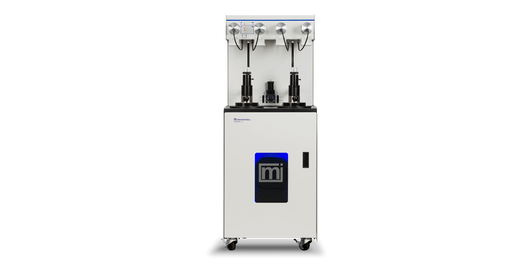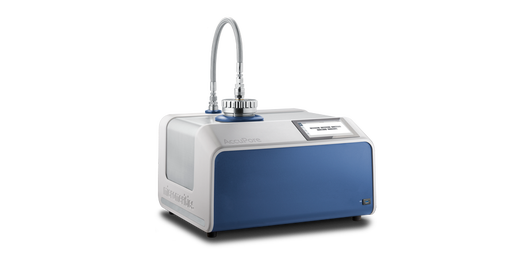
AccuPore
Precise through-pore analyzer for rapid, repeatable results across the widest sample range.

Precision porometers for advanced pore structure insight

A porometer is a precision analytical instrument used to characterize the structure of through-pores, that is, the pores that form a continuous channel all the way through a material, in materials like filters, membranes, separators, and non-wovens. Porometers measure through-pore diameter, size distribution, and connectivity by filling the pores of a sample with liquid, gradually increasing the pressure, and measuring the rate at which the liquid flows out.
With state-of-the-art porometer instruments like the Micromeritics AccuPore, material scientists can get highly accurate and detailed data on their materials’ internal pore architecture. This detailed insight ensures manufacturing performance and quality, and better real-world process predictions.
Capillary flow porometry (CFP) – also known as gas liquid porometry (GLP) – is a fast, reliable analytical technique used to determine the size and relative abundance of through-pores in sheets and membranes. From energy storage to automotives to pharmaceuticals, precision instruments like the Micromeritics AccuPore Capillary Flow Porometer delivers rapid, reliable insights into material behavior.
Capillary flow porometry analysis typically involves six steps:
The sample is soaked in an analysis liquid, typically a fluorinated liquid polymer. This wetting liquid seeps into the pores of the material, filling them with solution.
The material is placed into the capillary flow porometer, where it is subjected to increasing gas pressure using an inert gas, usually air or nitrogen.
This gas pressure builds over the sample until the first air bubbles are pushed through the material.
The rate at which bubbles are expelled from the material will correspond to the bubble point of the material or the largest through-pore in the material. As the pressure rises, smaller and smaller through-pores allow the flow of air.
As the capillary flow porometer depressurizes, it conducts the same measurement on the now-dry material.
Where the initial “wet curve” (from the wet analysis) and “dry curve” (from the dry analysis) meet will correspond to the smallest pore in the material. The data between the largest and smallest pore can be analyzed to obtain the entire through-pore size distribution.
The easiest, most accurate and versatile measurement of through-porosity
The Micromeritics AccuPore is the most precise through-pore porosity analyzer. It delivers rapid, repeatable results across the widest sample range, with easy method development and a simple, smart-automated workflow.
With AccuPore, materials scientists from research and development to quality control can access.
Discover MP Academy: expert-led courses and video lessons on materials characterization technologies, all in one place.
Learn at your own pace. Earn certificates. Accelerate your academic journey.

While porometers analyze how a fluid passes through the pores of a material - often focusing on the largest or most active pores that control performance, a porosimeter measures the overall pore structure, including pore size distribution, total porosity, and pore volume within the material.
Mercury intrusion porosimetry (MIP) forces non-wetting mercury into a sample under escalating pressures. Because mercury resists entering smaller pores until sufficient pressure is applied, the intrusion curve delivers detailed pore size distribution data over a wide range, from macropores to mesopores. It also delivers data on total pore volume and bulk or skeletal density.
Porometers such as the Micromeritics AccuPore Capillary Flow Porometer play a vital role in characterizing through-pore structure, flow behavior, and pore constriction sizes across a wide range of engineered materials. These are key parameters in the design and optimization of high-performance materials.
Below is an overview of the main industries where porometers deliver essential value.
Porometric techniques involving mercury or high-pressure gas demand safety that’s engineered in from the start. With Micromeritics' porometers, your operators and labs are protected by advanced safeguards. Plus, our global team of application scientists and service engineers are on hand to help ensure accurate results, reliable uptime, and confident support at every stage of your process.
Resources