
X-ray absorption near edge structure (XANES)
Advanced XANES spectroscopy, without leaving your lab

EXAFS spectroscopy for deeper structural insight

Extended X-ray absorption fine structure (EXAFS) is the oscillatory signal that appears in an X-ray absorption spectrum once the incident energy has moved beyond an element’s absorption edge, typically from around 50-100 eV above the edge.
EXAFS forms one of the two complementary regions of an X-ray absorption spectroscopy (XAS) measurement. Where X-ray absorption near-edge structure (XANES) is most sensitive to the oxidation state and coordination symmetry of the absorbing atom, EXAFS quantifies its local structure. This includes:
Because EXAFS is element-specific, it can deliver quantitative insights into an element’s surroundings, even within complex mixtures.

When X-rays are directed onto a sample, their energy can be absorbed by core electrons within the atoms of the material. Once the incident X-ray energy exceeds the electron's binding energy, at the absorption edge, an electron is ejected from the atom as a photoelectron.
This photoelectron travels outward from the absorbing atom as a wave and is partly backscattered by neighboring atoms. The backscattered wave interferes with the outgoing photoelectron wave at the absorbing atom, either constructively or destructively, depending on the distance to the neighboring atoms and the photoelectron's energy. This raises or lowers the probability of absorption.
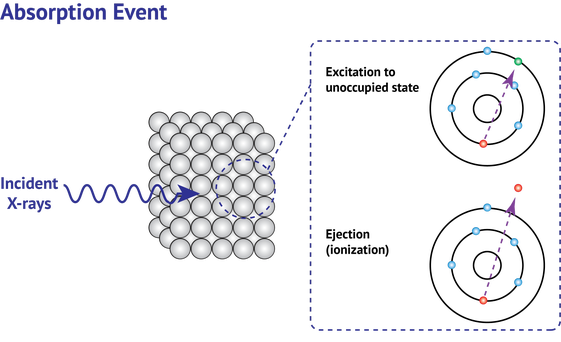
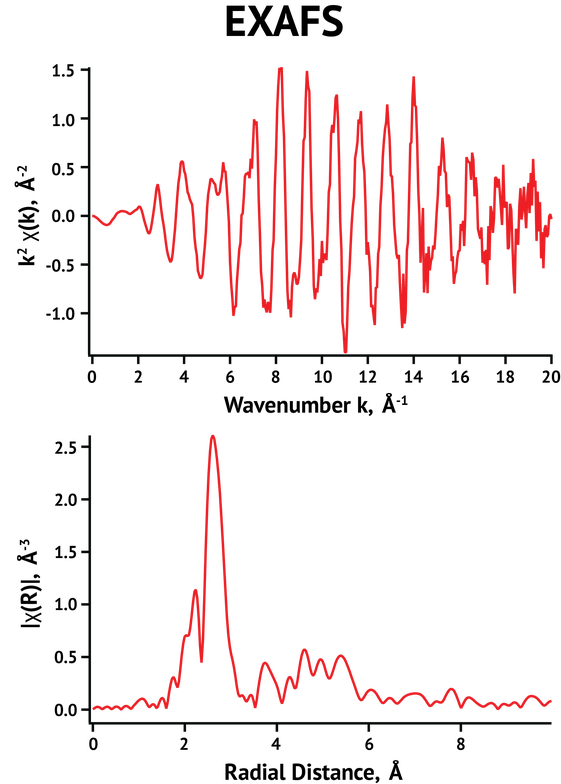
As the incident X-ray energy is scanned further beyond the absorption edge, this interference produces a series of oscillations in the measured absorption signal: the EXAFS spectrum. Because the interference pattern encodes information about the distances, number, approximate type, and structural disorder of surrounding atoms, these oscillations contain a detailed structural fingerprint of the absorbing atom's local environment.
To extract this structural information, the EXAFS oscillations are converted from photon energy to photoelectron wavenumber (k) and then Fourier transformed. This results in a pseudo-radial distribution function, in which peaks correspond to shells of neighboring atoms at different distances from the absorbing atom.
Because the photoelectron undergoes phase shifts as it scatters, these peaks appear at slightly shorter distances than the true interatomic distances. The data are therefore fitted to a structural model to determine:
Once the oscillations seen in the EXAFS region have been isolated, Fourier transforming this data into a pseudo-radial distribution function reveals:
Because EXAFS depends on the local environment around the absorbing atom rather than long-range periodic order, it can determine structure even in amorphous, disordered, or nanoscale materials where X-ray diffraction provides little or no useful signal. EXAFS is therefore a powerful tool for determining the local structure of materials, even in systems lacking long-range order.
EXAFS analysis supports research across a wide range of industries – wherever understanding precise local structure and bond distances matters more than average crystal structure. These include:
At the atomic scale, a catalyst's activity often comes down to the exact geometry of its active sites. EXAFS identifies bond lengths and coordination numbers that diffraction alone can't resolve, especially in materials with poor crystallinity or trace loadings, tracking how these local structures shift as a reaction proceeds and connecting structural change directly to catalytic performance.
During charge and discharge cycles, the local atomic structure of battery electrodes shifts as bonds lengthen, shorten, or break. EXAFS follows these structural changes through charge and discharge, helping researchers understand the degradation pathways that ultimately limit cell lifetime.
The small size and disordered surfaces of nanoparticles produce weak, broadened XRD peaks with little structural detail. EXAFS, unaffected by the loss of long-range order, can still resolve local coordination, distinguishing surface atoms from core atoms and helping explain size-dependent behavior at the atomic level.
EXAFS determines the coordination environment and bond distances of metal species bound to soils, sediments, and water, revealing how they interact with mineral surfaces and organic matter. This supports research into contaminant behavior and metal speciation in complex natural systems.




Add local chemical insight to your multipurpose X-ray platform
Because EXAFS oscillations are a weak signal, scans covering the full EXAFS range have traditionally required several hours of synchrotron beamtime to build up the signal-to-noise ratio a reliable quantitative fit requires. This extended measurement time only adds more pressure to the existing competition for synchrotron facility availability.
Malvern Panalytical’s Empyrean XAS solution is designed to change this, by bringing EXAFS measurements directly to the lab.
Empyrean XAS includes:
Empyrean XAS enables researchers to:
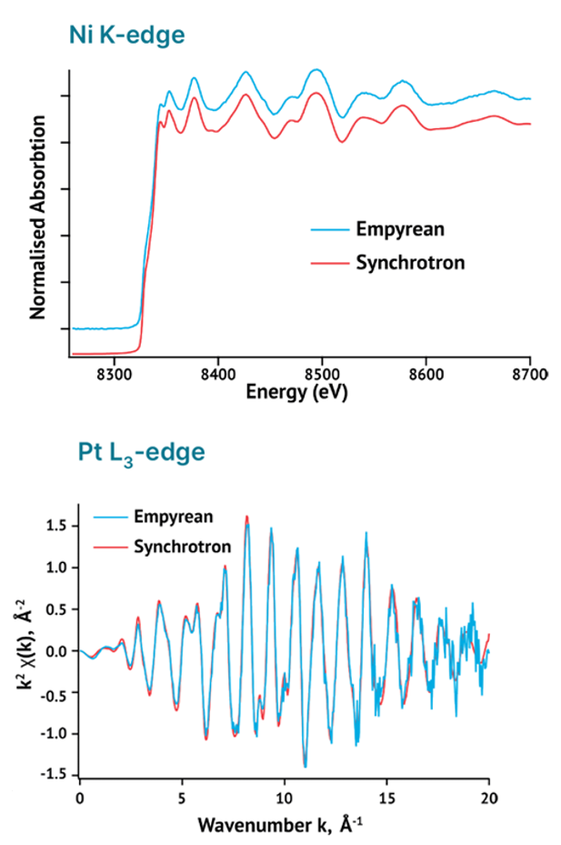
Empyrean XAS supports measurements across a wide portion of the periodic table, analyzing K-edges of mid-Z elements (such as Ti, Fe, Ni, and Mo) and L-edges of heavier elements (such as Ba and Ce) – with an accessible energy range of 4–20+ keV.

Empyrean XAS enables laboratory-based XANES and EXAFS measurements, providing local chemical insight that complements traditional X-ray diffraction.
